
How the tropical zodiac is measured
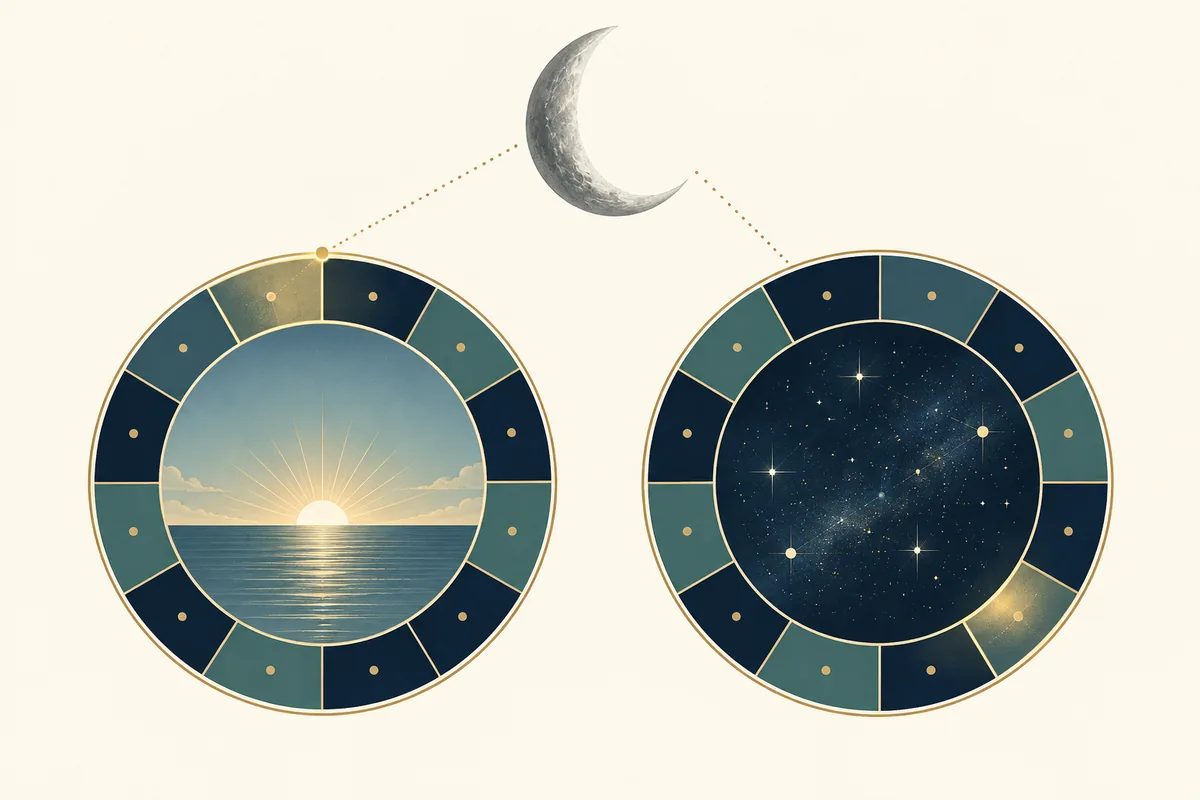
The tropical zodiac is season-based. It sets 0 degrees Aries at the March equinox, the point in the year when the Sun crosses the celestial equator moving north. The remaining signs follow as twelve equal 30-degree divisions along the ecliptic, the apparent path the Sun traces across the sky. In this framework, the seasonal cycle provides the zodiac's starting point.
Because this anchor follows the equinox, tropical boundaries slowly shift relative to distant stars over long timescales. The signs remain equal divisions; they are not recalculated from constellation outlines.
What a tropical Moon sign describes
A tropical Moon sign is the 30-degree segment containing the Moon's tropical longitude at birth. A calculator maps an estimated position to one of twelve signs, so the birth time and time zone matter near a boundary. The sign is a coordinate label within astrology, not a measured emotional trait.
How the sidereal zodiac is measured
Sidereal means star-related. A sidereal zodiac uses a stellar reference to set its sign positions rather than starting Aries at the March equinox. To compare a tropical longitude with a sidereal one, a calculation applies an offset commonly called ayanamsha. The chosen reference and offset determine where each sidereal sign begins; the twelve signs are still equal 30-degree sectors.
There is no single universal ayanamsha. Lahiri is widely used in Indian Jyotish, while other lineages and software use different conventions. The offset changes over time, so a sidereal chart should name its ayanamsha when precision matters, especially near a sign boundary.
Sidereal signs are not the same as astronomical constellations
The twelve sidereal signs are equal divisions, not outlines of the modern constellations, which vary in width. “Star-based” describes the reference frame; it does not mean every sign exactly matches a visible constellation.
Why the same birth can produce a different Moon sign
Both calculations use the same birth instant and physical Moon; they differ in the coordinate frame used to label its longitude. Subtracting a sidereal offset may place the Moon in the preceding sign, but not everyone moves back exactly one sign. A position can remain in the same sign, and ayanamsha choice matters near a boundary.
For example, a tropical position at 5 degrees Aries minus an illustrative 24-degree ayanamsha lands near 11 degrees Pisces sidereally. This simplified arithmetic explains the frame change; it is not a birth result or a prediction about behavior.
Birth time still matters in both systems
The Moon moves throughout the day. Near a boundary, a few minutes or a time-zone error can change the sign in either system. Zodiac choice and time-zone conversion are separate: sidereal settings cannot repair an unknown or inaccurate birth time.
- Keep the recorded local time and birthplace time zone together.
- Check the calculator's zodiac setting before comparing two results.
- Treat a result near a sign boundary as uncertain when the birth time is uncertain.
Sidereal, Vedic, and Western are not identical terms
Many Western astrology charts use tropical positions, and many Jyotish or Vedic charts use sidereal positions with a named ayanamsha. These are common associations, not definitions of every practice. “Western” and “Vedic” describe broader traditions; “tropical” and “sidereal” describe zodiac reference frames. Treating the pairs as exact synonyms confuses a coordinate choice with a whole tradition.
Vedic readings may give the Moon a central role and use additional chart factors or interpretive methods. The tropical and sidereal Moon signs answer a narrower question about where the Moon falls under each reference; they do not make complete charts interchangeable.
What stays the same across the comparison
Both labels refer to the Moon at a particular moment, and both use twelve sign names. Switching settings does not move the sky; it changes the coordinate frame. If two sites differ, compare their settings and birth data before assuming one calculation is wrong.
How to choose a system and read your result
No evidence-based test identifies one zodiac framework as scientifically correct for describing personality. Use the settings taught by the tradition you study. When comparing calculators, enter the same birth date, local time, and time zone, then check the zodiac method shown with each result.
Record the system and ayanamsha alongside the birth data. Compare like with like, and do not mix an interpretation from one framework with the calculation settings of another. Treat astrology as a symbolic prompt for reflection, not a fixed description or a substitute for evidence and professional advice.
- Use tropical when you want the seasonal reference used by this site's calculator.
- Use sidereal when you are following a sidereal or Jyotish calculation, and note the ayanamsha.
- Recheck birth-time and time-zone details before comparing results.
Which zodiac system does this Moon sign calculator use?
This calculator uses a lightweight astronomical approximation for a tropical Moon position based on birth date, local time, and time zone. It has no sidereal mode or ayanamsha selector, so its result is not a Vedic Moon sign calculation and should not be compared as though the settings match.
This is a browser-based estimate, not a full natal chart or professional astronomy software. For a sidereal Moon sign, choose a calculator that names its method and ayanamsha. For this site's tropical estimate, enter the birthplace time zone; the birth-date guide explains the limits when the exact time is unknown.
Tropical vs. sidereal Moon sign at a glance
The practical difference is the reference used to assign a sign, not a different physical Moon. Check these settings before comparing two calculator results.
| Approach | Starting reference | What the Moon sign labels |
|---|---|---|
| Tropical | March equinox; seasonal coordinate frame | The tropical 30-degree sign containing the Moon's longitude |
| Sidereal | A stellar reference adjusted by a named ayanamsha | The sidereal 30-degree sign containing the adjusted longitude |
Tropical and sidereal Moon sign FAQs
Why is my Vedic Moon sign different from my Western Moon sign?
Many Western charts use a tropical zodiac, while many Vedic or Jyotish charts use a sidereal zodiac. The sidereal calculation applies an ayanamsha, so the same birth moment can fall in a different sign. Compare the exact zodiac setting, ayanamsha, birth time, and time zone before deciding whether a result is inconsistent.
Is a sidereal Moon sign more accurate?
Accuracy depends on what you mean by the result. A chart can calculate a position consistently within a stated zodiac system, but astrology has not been shown to provide a scientific personality measurement. Choose the system used by the tradition you are studying and make sure the birth data are correct.
Does sidereal mean the sign matches the actual constellation?
No. Sidereal signs use a stellar reference, but the twelve signs remain equal 30-degree sectors. They are not the same as the modern astronomical constellations, whose boundaries and sizes are unequal.
What is ayanamsha in a Moon sign calculation?
Ayanamsha is the angular offset used to relate tropical and sidereal zodiac positions. Different sidereal settings can use different reference conventions, so the selected ayanamsha can affect a result near a sign boundary.
Can my Moon sign stay the same in both systems?
Yes. The systems use different reference points, but an offset does not guarantee that every position crosses a sign boundary. A Moon near the later degrees of a tropical sign may still map to that sign under a particular sidereal setting.
Which system does this calculator use?
This calculator reports a tropical Moon sign using a lightweight astronomical approximation. It does not offer a sidereal setting or an ayanamsha selector.
Read the label in context
Tropical and sidereal are calculation conventions used in astrology. A Moon sign is one symbolic placement, not a complete account of a person and not a scientifically validated measure of emotion or behavior. When another calculator gives a different label, compare its settings and the birth data first.
For a technical reference on software that calculates tropical and sidereal positions, see the Swiss Ephemeris programming documentation.
Open the Moon sign calculator · Read the Moon sign meaning guide · Find a Moon sign by birth date